AppSky
Katz Index (ADL scale): scoring and Belgian care forfaits
How the Katz Index (ADL scale) scores six daily-living activities and when a home-nursing patient qualifies for forfait A, B or C. With a calculator.
Written by
Read time
6 min read
Posted on
July 8, 2026
Katz score calculator
Six short steps. For each criterion, pick the description that matches the patient. The score and forfait indication appear at the end.
Indicative tool based on art. 8 of the RIZIV/INAMI nomenclature. The evaluation and the request to the insurance fund remain the nurse’s responsibility.
Table of contents
- What is the Katz Index?
- Does the total number of points matter?
- From scores to forfait A, B or C
- A worked example
- No forfait? Hygiene care can still be covered
- Who fills in the scale, and what happens next?
- Katz scale or BelRAI?
- Frequently asked questions
- What does a Katz score of 4 mean?
- How many points do you need for a forfait?
- How long does a Katz evaluation stay valid?
- The Katz scale inside your own care software
The Katz Index is a standardized six-item scale, also called the Katz ADL scale, that measures how independently a person carries out the basic activities of daily living (ADL). In Belgian home nursing it has a specific role: it is the “evaluation scale” of article 8 of the RIZIV/INAMI nomenclature, used to objectify how care-dependent a patient is. Each activity is scored from 1 (fully independent) to 4 (fully dependent). That profile decides whether care is billed per act or falls under a daily lump sum: forfait A, B or C.
Use the calculator above to fill in a score and see the forfait indication straight away. How the scale works, and where the thresholds between forfaits sit, is set out below.
What is the Katz Index?
The scale is named after the American physician Sidney Katz, who introduced the ADL index in a landmark 1963 study. The Belgian home-nursing version is set out in article 8 of the nomenclature of health services. It differs from the international index: six physical criteria, four score levels each, plus an assessment of disorientation in time and space.
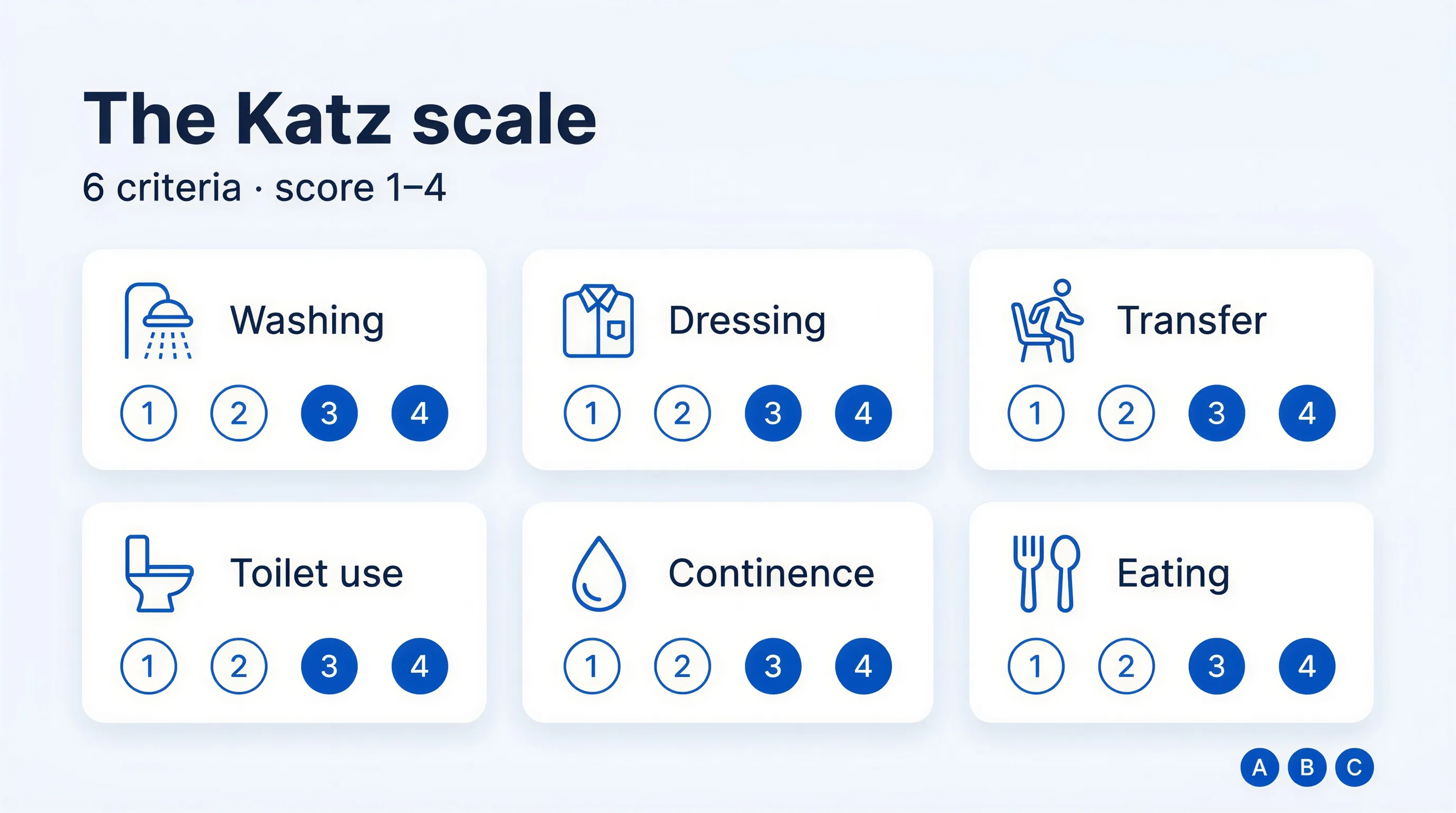
The six criteria are:
- Washing
- Dressing
- Transfer and moving around
- Toilet use
- Continence
- Eating
For each criterion you pick the description that best fits the patient. The exact wording per score is in the calculator above. A patient counts as dependent on a criterion from score 3.
Does the total number of points matter?
No. It is nonetheless the most common misconception. The total score (6 to 24 points) only gives a rough indication of care intensity. For the forfaits, RIZIV/INAMI does not look at the total but at the pattern per criterion: which score the patient has on which activity. Two patients with the same total can land in different forfaits, or outside the system entirely.
From scores to forfait A, B or C
The forfaits are daily fees for heavily care-dependent patients. They assume at least one hygiene care per care day and follow these article 8 criteria:
| Forfait | Conditions |
|---|---|
| A | Dependent for washing and dressing (score 3 or 4), plus dependent for transfer and/or toilet use (score 3 or 4) |
| B | Dependent for washing and dressing, plus transfer and toilet use, plus continence and/or eating (score 3 or 4 each) |
| C | Score 4 for washing, dressing, transfer and toilet use, plus dependent for continence and eating, of which at least one scores 4 and the other at least 3 |
Forfait C requires at least two visits per care day. With a single visit, only a forfait B can be billed.
How those forfaits are actually invoiced — per act versus a daily lump sum, over the third-party-payer channel — is covered in the RIZIV/INAMI home-nursing financing guide, part of the wider overview of how Belgium assesses and finances home nursing.
A worked example
Take a patient who scores 3 for washing, 3 for dressing, 4 for transfer and 2 for toilet use, and 1 for both continence and eating. They are dependent (score 3 or 4) for washing and dressing, and also for transfer. That combination satisfies forfait A: dependent for washing and dressing, plus dependent for transfer and/or toilet use. The total here is 14 points, but the total is not what decides it — the pattern is. Now raise the same patient’s toilet-use score to 3 and add dependence for continence: washing and dressing stay dependent, transfer and toilet use are now both dependent, and continence is dependent too. The profile shifts to forfait B. This is exactly why two patients with an identical 14-point total can bill under different forfaits, or none at all.
No forfait? Hygiene care can still be covered
If the profile reaches no forfait, care is billed per act. Patients who are dependent for hygiene care can still receive the reimbursed “toilets” (hygiene sessions): by default at most two a week (the T2 fee), and in specific situations up to seven a week, one a day at most (the T7 fee). If a patient is disoriented in time and space, the treating physician can attest this, which opens more frequent hygiene care even at lower physical scores.
Who fills in the scale, and what happens next?
In home nursing, the nurse completes the evaluation scale, based on what the patient still does independently in practice, not on what they could do in theory. The scale goes electronically via MyCareNet to the advisory physician of the patient’s health insurance fund, in principle within ten calendar days of the first care act it covers.
RIZIV/INAMI also audits scoring quality. During checks, including the Kappa tests, it verifies that the recorded scores match the patient’s actual condition. Score what you observe, and note why.
Katz scale or BelRAI?
In Flemish elderly care and family care, Katz-based assessment is gradually being replaced by BelRAI and the BelRAI screener, a broader assessment instrument rolled out at federal level. For the RIZIV/INAMI forfaits in home nursing, the Katz scale is still the norm today. Organizations working in both contexts may use the two instruments side by side.
Frequently asked questions
What does a Katz score of 4 mean?
Score 4 on a criterion means the patient is fully dependent on others for that activity. For example, being bedridden for the transfer criterion, or incontinent for both urine and faeces for the continence criterion.
How many points do you need for a forfait?
There is no points threshold: forfaits are determined by the combination of scores per criterion (see the table above), not by the total.
How long does a Katz evaluation stay valid?
The evaluation must reflect the patient’s current condition. If dependence changes, a new scale is drawn up. Renewals and validity periods follow the rules of the nomenclature and the insurance fund.
The Katz scale inside your own care software
Filling in, submitting and following up Katz scales every week is exactly the kind of admin we like to make disappear. In the software we build for home-nursing teams, the evaluation, its MyCareNet submission and the care plan live on one screen, so a score is entered once from the nurse’s recorded observations rather than retyped between systems — the step where transcription mistakes usually creep in. AppSky builds custom software for home-nursing and home-care organizations, where evaluations, care planning and billing sit in one flow. See what we did for Domihome, or book an intro call.
This guide is informational and not billing or medical advice. The nomenclature evolves: consult the official criteria on the RIZIV/INAMI evaluation-scale page. Last verified 8 July 2026.
Print the Katz scoring sheet (PDF)
A blank one-page sheet with all six criteria, every score description and the forfait key. Print it or save it as PDF to use at the bedside.