AppSky
RIZIV/INAMI home-nursing financing in Belgium explained
How a home nurse in Belgium actually gets paid: the article 8 nomenclature, per-act billing versus the Katz-based forfaits A/B/C, and the third-party-payer principle.
Written by
Read time
10 min read
Posted on
July 14, 2026

Table of contents
- What does RIZIV/INAMI finance in home nursing?
- Per-act billing versus the forfait
- What is the third-party-payer principle?
- How does the money actually move electronically?
- A worked example
- The 2026-2028 financing pilot
- Frequently asked questions
- What is the difference between per-act billing and a forfait in Belgian home nursing?
- Does the patient pay the home nurse directly?
- Which nomenclature article governs home nursing?
- Is Belgium changing how home nursing is financed?
- When the financing rules live in your software, they can’t be an afterthought
RIZIV/INAMI home-nursing financing is the set of rules that decides how a home nurse in Belgium gets paid: every reimbursable service sits in article 8 of the nomenclature, it is billed either per act or as a Katz-based daily forfait A, B or C, and the money flows to the provider through the third-party-payer principle rather than from the patient’s pocket. If you build or run software for a home-nursing organization, these four mechanics (the nomenclature, per-act versus forfait, third-party payer, and the electronic channel that carries it) are the data your product has to get right, because a wrong code or a rejected invoice is unpaid work.
This guide gives the operator’s view of how the money actually moves. It is the companion to the Katz scale, which is where the forfaits are decided; this one picks up where that leaves off: how the care actually gets paid. For the full picture of assessment and financing together, see the pillar guide on home-nursing assessment and financing in Belgium.
What does RIZIV/INAMI finance in home nursing?
RIZIV/INAMI (the federal health-insurance institute, RIZIV in Dutch, INAMI in French) reimburses home nursing only for the services written into article 8 of the nomenclature of health services. That is the rule to internalise first: if an act is not in article 8, it is not reimbursed. The nomenclature is not a price list you read top to bottom; it is a structured catalogue of what counts as a billable nursing service and under what conditions.
Within article 8, the services fall into a few broad families:
- Base per-act care sessions: the ordinary nursing visit, counted per act (the day’s first, second, and further base acts each have their own rules).
- Hygiene care (“toilets”): reimbursed hygiene sessions for patients who are dependent for personal care but do not reach a forfait.
- Specific technical acts: the discrete clinical procedures (injections, wound care, catheters, perfusions and the like), each with its own nomenclature line.
- Daily forfaits A, B and C: lump sums for heavily dependent patients, keyed off the Katz profile.
The first three are billed per act. The forfaits are a different animal, and the distinction is the heart of home-nursing financing.
Per-act billing versus the forfait
Per-act billing does what it says: each service in article 8 is charged separately, act by act, at its own nomenclature value. A patient who needs a daily insulin injection and a weekly wound dressing generates a line for each act performed.
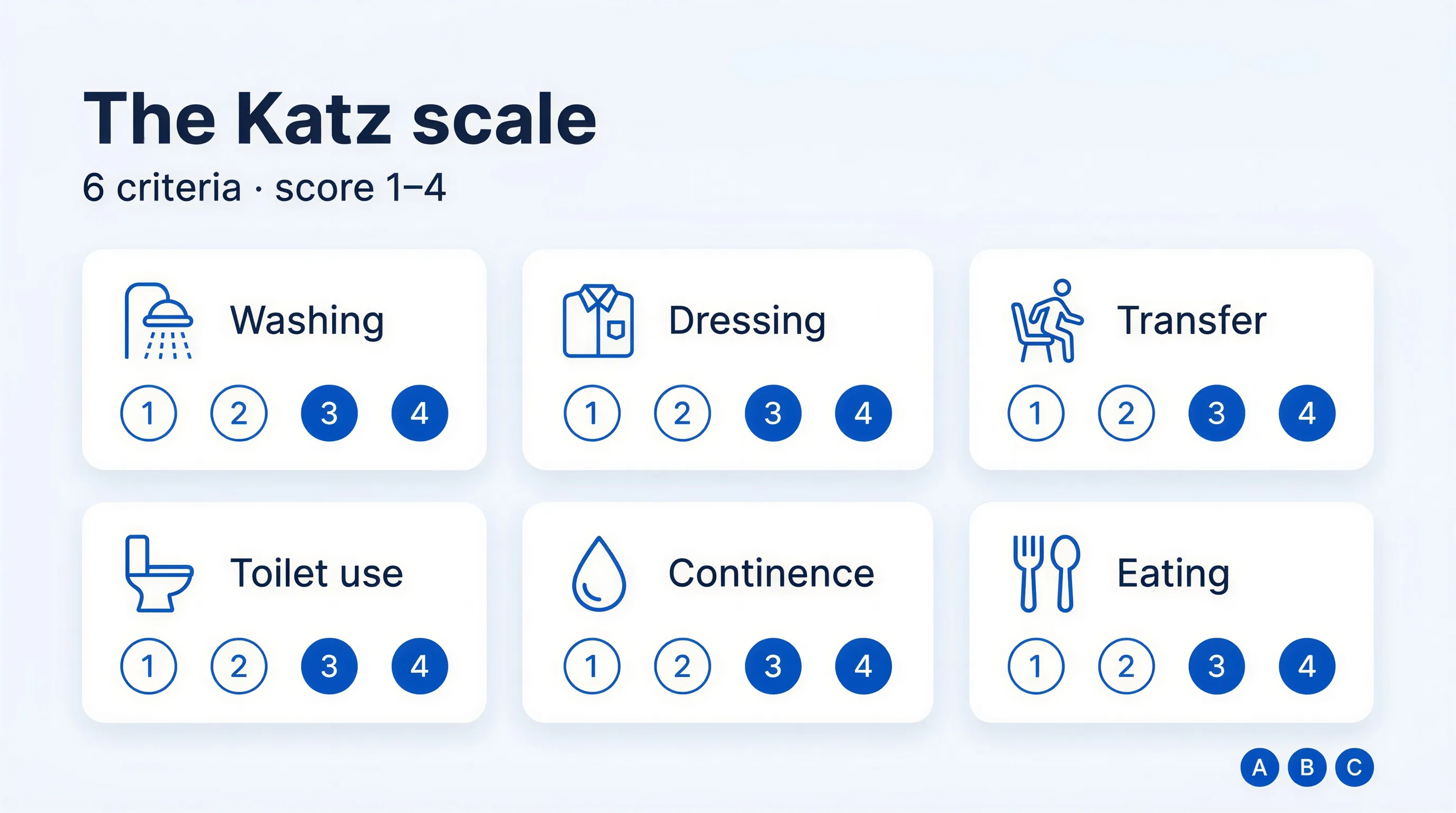
A forfait replaces that act-by-act count with a single daily fee. Forfaits A, B and C are granted once per day of care and cover all the nursing care given that day to a heavily care-dependent patient. You do not also bill the individual acts on top. Which forfait applies is decided not by the total but by the patient’s Katz dependency profile against the criteria in article 8: forfait A is the lightest of the three, C the heaviest, each defined by specific combinations of score-3 and score-4 across the Katz criteria (washing, dressing, transfer and mobility, toilet use, continence, eating). Forfait C carries an operational condition worth flagging: it requires at least two visits per day of care. With a single visit, forfait C cannot be attested.
The mechanics of which profile lands in which forfait belong to the Katz scale guide and its calculator: that is the assessment side. The financing point here is simpler: the same patient, same day, is paid for in one of two fundamentally different ways, and your software has to know which regime a patient is in before it can produce a correct invoice.
One thing not to confuse: the patient-level forfaits A/B/C are distinct from a separate quarterly financing grant paid to nursing services as organizations. Different mechanism, different money. Keep them apart in any billing model.
A note on euro amounts: the nomenclature expresses values in coefficient units, and the euro tariff is a separately indexed document that is re-set periodically. This guide deliberately does not quote a euro figure. Check the current tariff sheet on the official RIZIV/INAMI site for today’s numbers.
What is the third-party-payer principle?
In most of Belgian outpatient care the patient pays the provider and is reimbursed afterward. Home nursing works the other way, through the third-party-payer scheme: tiers-payant in French, derdebetalersregeling in Dutch. Under it, the nurse or organization invoices the patient’s health insurance fund (mutualité / ziekenfonds) directly for the reimbursed amount, and the patient does not pay that part up front.
This is the standard, near-universal model for home nursing. The whole invoicing workflow is built around it. It is the reason a home-nursing organization is, in cash-flow terms, billing the insurers rather than chasing patients. And it comes with a hard requirement: when third-party payer is applied, the invoicing has to be sent electronically through MyCareNet. Paper is not the fallback for third-party-payer billing; the electronic channel is the channel.
(“Tiers-payant” / “derdebetalersregeling” is also the term patients and referrers use, so it is worth naming plainly: it is the same principle whether you meet it in a nomenclature note or a patient conversation.)
How does the money actually move electronically?
The pipe is MyCareNet. It is the central platform through which a home nurse exchanges data with the health insurance funds, and it carries several distinct flows that together make up the financing loop:
- Insurability checks: confirming, before or during care, that the patient is actually covered and on what terms.
- The Katz notification: the evaluation scale and the toilet/forfait requests are transmitted electronically to the advisory physician (médecin-conseil / adviserend arts) of the patient’s fund.
- Third-party-payer invoicing: the billing files go out through MyCareNet via eFact, the electronic third-party-payer invoicing eService. eAttest, the separate cash-payment eService, is for doctors, dentists and physiotherapists and does not apply to third-party-payer home nursing.
- Notifications back: the fund can respond electronically, including refusing a forfait request, and those answers return through the same channel.
Behind the invoicing sits the NIC (National Intermutualist College / Collège Intermutualiste National / Nationaal Intermutualistisch College), the intermutualist hub that receives the billing files, validates them and routes settlement to the individual funds. For a software point of view, that is the shape to hold in your head: the provider talks to one electronic front door, and the machinery behind it fans the data out to the right insurer.
The detail of building and maintaining that integration (the message formats, the insurability calls, the invoicing round-trip) is its own subject. We cover it in the companion guide on MyCareNet, eHealth and home-care billing.
A worked example
Take one patient over one day of care. If that patient needs, say, a single technical act (an insulin injection) and does not reach a forfait profile, the organization bills that act under its article 8 line, per act. Under the third-party-payer scheme, the invoice for the reimbursed amount goes not to the patient but to their fund, electronically through MyCareNet, and settlement comes back through the NIC.
Now take a heavily dependent patient on the same day. Their Katz profile meets the article 8 criteria for a forfait, so the day is billed as a single daily forfait rather than act by act: one lump sum covering all the nursing care given that day, not a line per act. If their profile is the heaviest, forfait C, the same operational rule from earlier applies: the day has to include at least two visits for that forfait to be attested; a single visit that day would drop it to what a single-visit profile allows. Either way, per act or forfait, the invoice travels the same third-party-payer path to the fund. The regime changes what is billed; the third-party-payer channel is how it reaches the money in both cases.
Every number in that example is a mechanism, not a euro figure, deliberately, because the euro tariffs move and the rules do not.
The 2026-2028 financing pilot
It is being tested. Belgium is running a federal pilot, coordinated with the KCE (the federal healthcare knowledge centre), across 2026-2028, that trials a new home-nursing financing model paying for care time rather than the per-act and Katz-forfait logic described above. Assessment instruments including BelRAI feature in the pilot. Two honest caveats: it is a pilot, running in a limited set of practices, not the general rule; and BelRAI appears in it as an assessment instrument, not as a confirmed new payment key. Treat the whole thing as true when checked: the start dates and design details were still moving as this was written, and a pilot is not a reform until it ships.
For a home-nursing product, the practical stance is: build for article 8 and the Katz forfaits as they stand today, but keep the assessment layer loose enough that a time-based or BelRAI-informed model would not require ripping the foundations out.
Frequently asked questions
What is the difference between per-act billing and a forfait in Belgian home nursing?
Per-act billing charges each nursing service in article 8 separately, act by act. A forfait A, B or C is a single daily lump sum granted once per day of care for a heavily dependent patient whose Katz profile meets the article 8 criteria — it covers all the nursing care that day rather than being counted act by act.
Does the patient pay the home nurse directly?
Usually not. Under the third-party-payer scheme (tiers-payant / derdebetalersregeling), the standard model for home nursing, the nurse or organization invoices the health insurance fund directly and the patient does not pay the reimbursed amount up front. When third-party payer is applied, that invoicing has to go electronically through MyCareNet.
Which nomenclature article governs home nursing?
Article 8 of the nomenclature of health services. It lists the reimbursable nursing services — the per-act base sessions, hygiene (toilet) care and specific technical acts — and sets the Katz-based criteria for the daily forfaits A, B and C. Only services listed in article 8 are reimbursed.
Is Belgium changing how home nursing is financed?
A federal pilot is testing it. Coordinated with the KCE and running across 2026-2028, it trials a time-based financing model instead of the per-act and Katz-forfait system, using assessment instruments including BelRAI. It is a pilot, not the general rule, and the specifics are still moving — treat any detail as true when checked.
When the financing rules live in your software, they can’t be an afterthought
Every one of these mechanics (which regime a patient is in, whether a forfait’s visit condition is met, whether an invoice cleared MyCareNet) is a place where money quietly goes missing when the software and the workflow disagree. Building Domihome, the thing that surprised us most was how much of the financing lives in the edges: the forfait that fails because the second visit wasn’t logged, the invoice a fund silently refused. So we made the care record, the forfait logic and the MyCareNet invoicing share one source of truth, rather than reconcile three. AppSky builds custom software for home-nursing and home-care organizations, where assessment, care planning and billing sit in one flow. See what we did for Domihome, or book an intro call.
This guide is informational and not billing, legal or medical advice. The nomenclature and its tariffs evolve, and the new-financing pilot is still in transition. Confirm current rules and figures with the official sources: the article 8 nomenclature texts, the MyCareNet page for home nurses, and the pilot on new home-nursing financing. Last verified 14 July 2026.